
>60%
>95%
Zero
- >60% Throughput Enhancement – Continuous Auto Kaizen™ optimization delivers significant higher user throughput
- ~25% Response Latency Reduction – Auto Kaizen™ ensures consistently fast responses, reducing latency variability and improving end-user experience
- Up to 95%+ Memory Utilization – Memory Walking Technology ensures safe operation at peak efficiency
- 100+ Server Scalability – Enterprise-ready federation supports seamless expansion across 100+ servers
- 0% OOM Events – Multi-layer protection guarantees complete elimination of out-of-memory failures
Challenges
Deploying Large Language Models (LLMs) at enterprise scale pushes GPU clusters to their absolute limits. Traditional static configurations cannot adapt to dynamic workloads, leading to instability, wasted resources, and frequent service disruptions. Key challenges include:
- The Memory Cliff: Running massive models like DeepSeek-R1 (671B) on 8×H20 GPUs consumes nearly all available memory, leaving less than 13% for the key-value (KV) cache, activations, and overhead. This razor-thin margin creates a constant risk of out-of-memory (OOM) crashes.
- Unpredictable Workloads: LLM inference demands fluctuate by language, context length, and concurrency. Static configurations fail to handle spikes such as product launches or sudden Chinese-language workloads, which require up to 2.5× more memory.
- SuboptimalHidden Cost of OOM Events: Each OOM event triggers complete service outages of 3–5 minutes, plus cache rebuilds and manual DevOps intervention. In typical deployments, 5–10 OOM events per hour can result in up to 66% downtime.
- Inefficient Resource Utilization: To avoid OOM failures, enterprises often operate GPUs conservatively at 60–70% utilization, wasting expensive hardware capacity and inflating infrastructure costs.
The Solution – Federator.ai GPU Booster Inference™
Federator.ai GPU Booster Inference™ eliminates the risks of static inference configurations by introducing Auto Kaizen™, a patent-pending continuous optimization engine. Instead of relying on fixed parameters, the platform adapts dynamically to workload changes, guaranteeing stability, efficiency, and zero downtime.
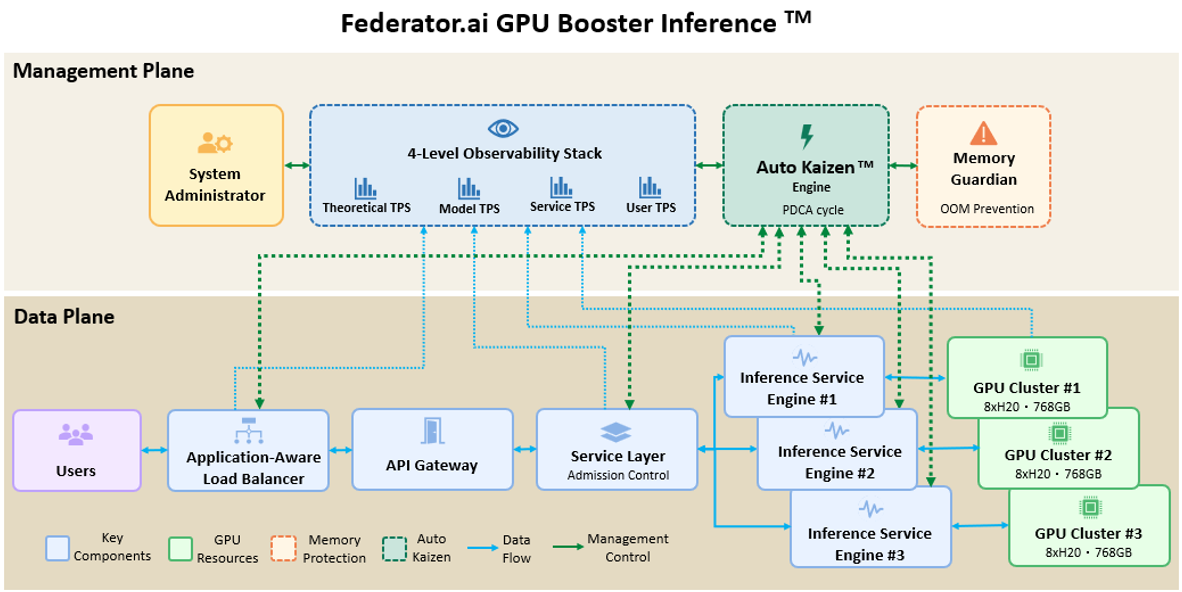
- Auto Kaizen™ Continuous Optimization: Continuously executes a PDCA (Plan-Do-Check-Act) cycle to adjust a substantial set of optimization dimensions—including batch size, caching, scheduling, and memory management—without human intervention.
- Zero OOM Guarantee: Multi-layer protection combines predictive admission control, machine-learning-based memory forecasting, token budget management, and intelligent request preemption to ensure complete elimination of OOM failures.
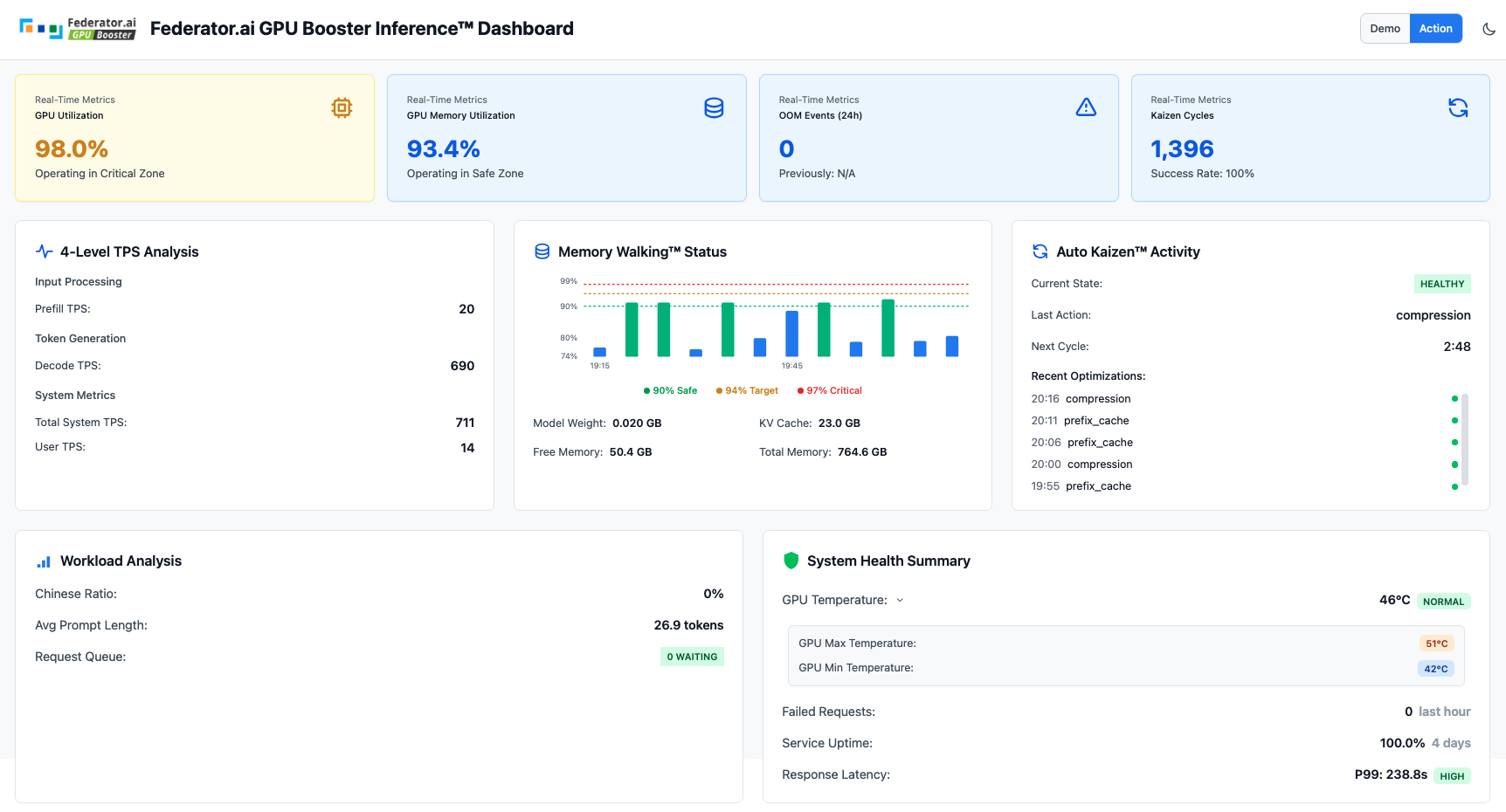
- Memory Walking Technology: Safely drives GPU utilization up to 95–96%, compared with the conservative 80–85% typical of traditional deployments.
- Enterprise-Ready Architecture: Docker-compatible, scalable to 100+ servers, and integrated with security, monitoring, and load balancing frameworks for high availability and seamless deployment.
Breakthrough Features
- Auto Kaizen™ Engine: Industry-first PDCA-based continuous optimization system that automatically tunes batch sizes, memory allocation, caching strategies, and more—improving performance with zero human intervention.
- 4-Level Observability: Complete visibility from theoretical hardware limits to actual user experience. Track performance at hardware, model, service, and user levels to identify and eliminate bottlenecks.
- Memory Walking Technology: Safely utilize up to 96% through predictive modeling and instant response to pressure.
Federator.ai GPU Booster Inference™ Architecture
Federator.ai GPU Booster Inference™ Dashboard
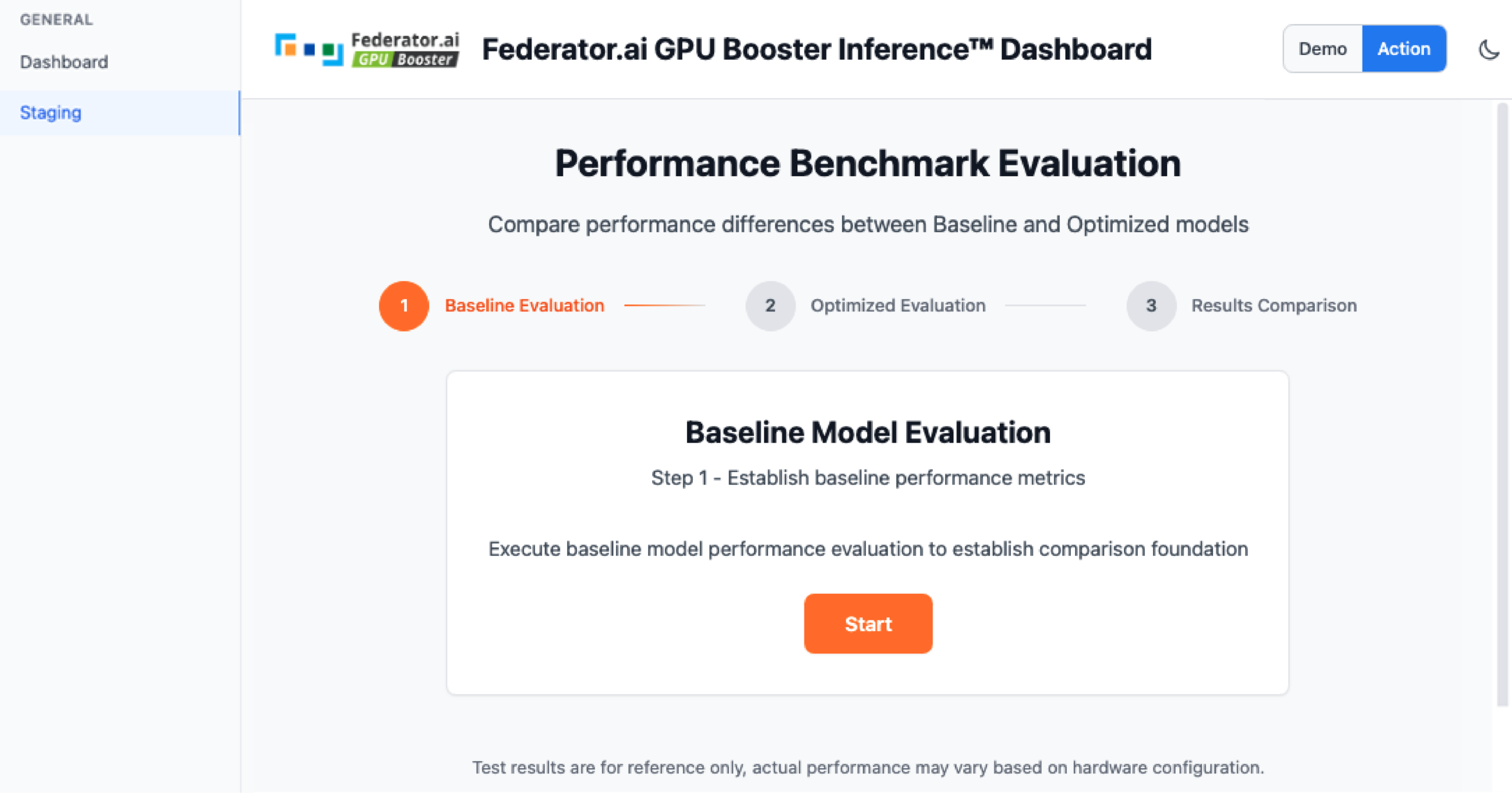
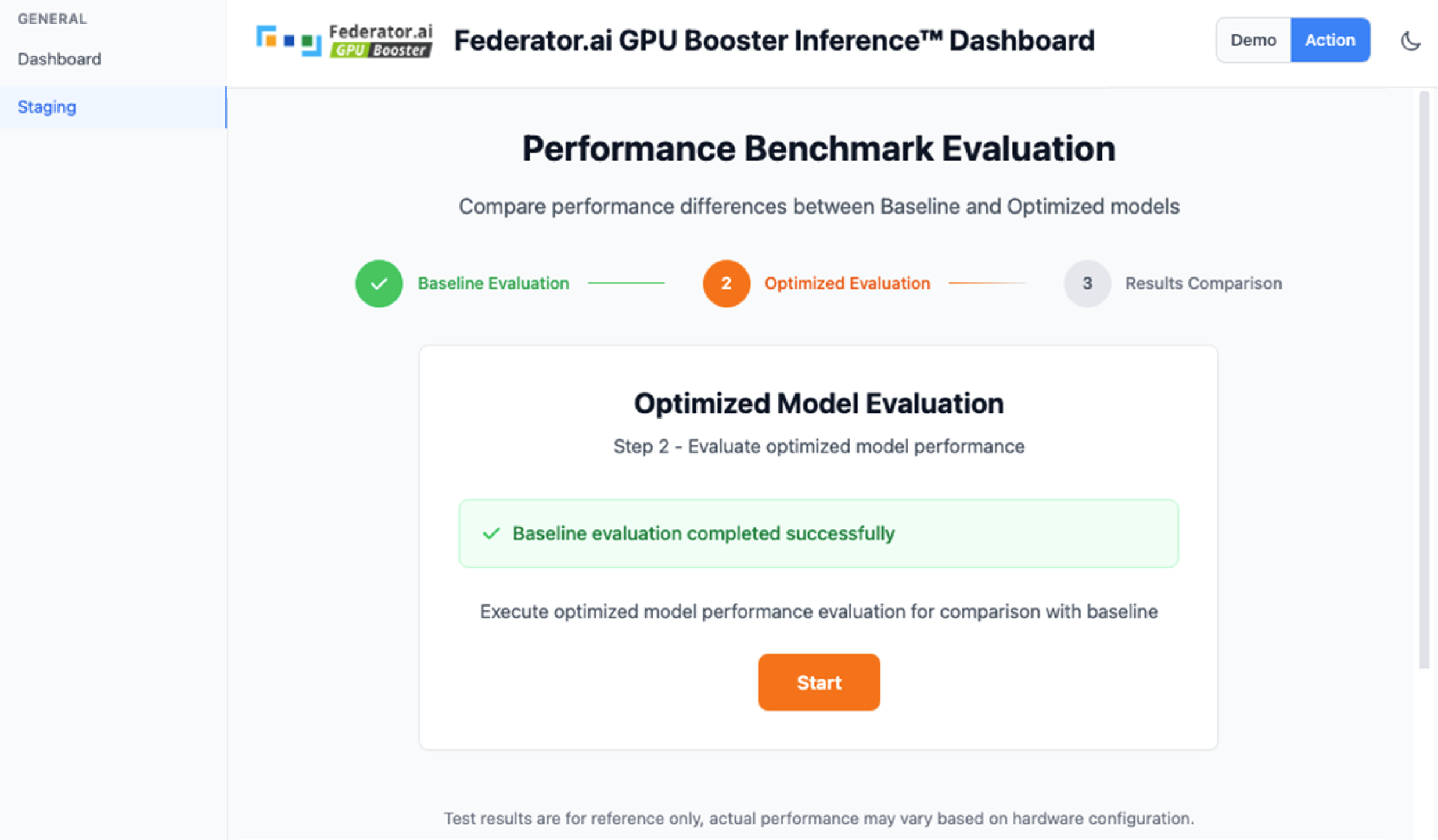
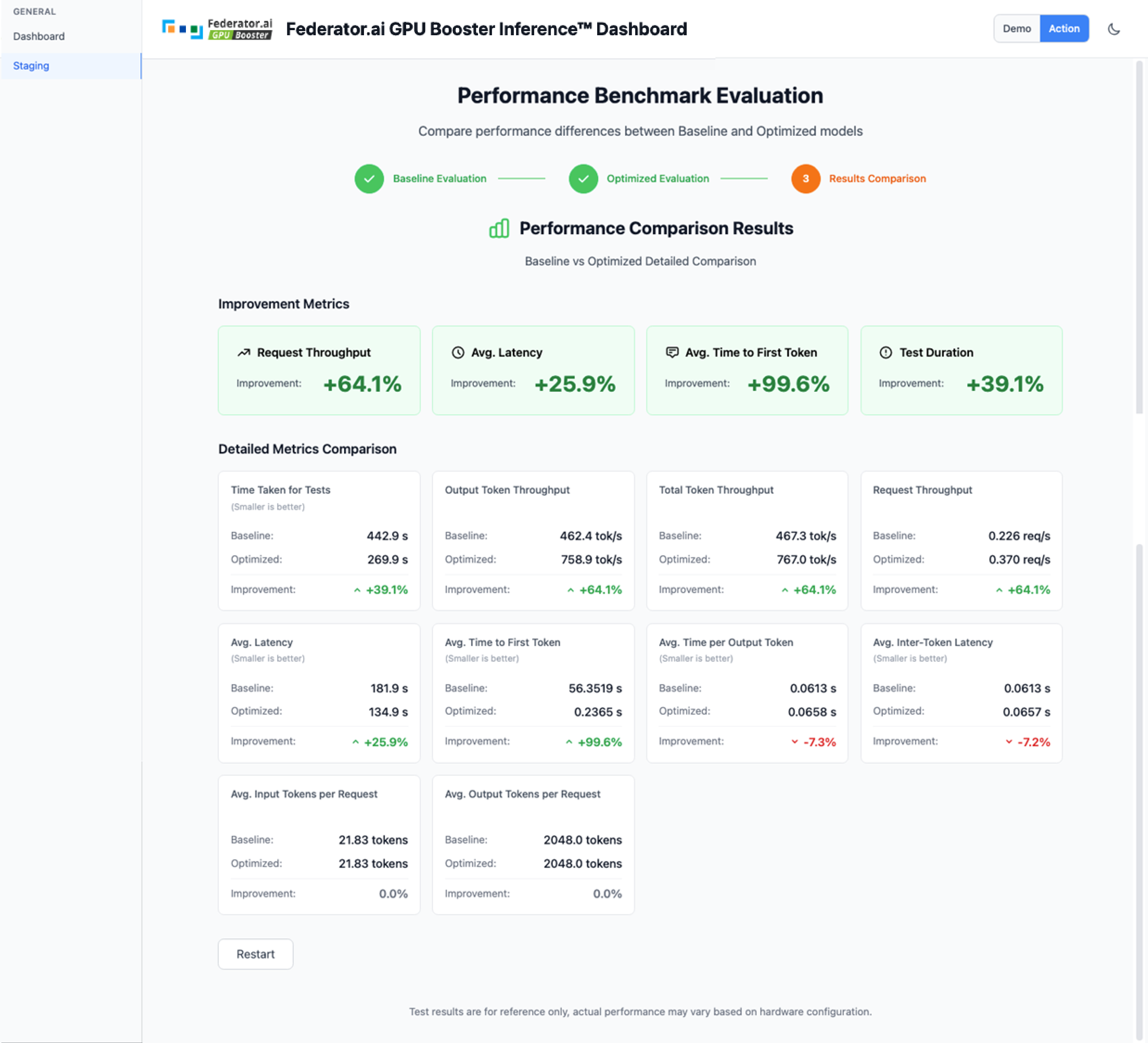
Proven Performance Gains
| Metric | Traditional Deployment | With Auto-Kaizen™ | Improvement |
|---|---|---|---|
| User Throughput | Baseline | Significantly Higher | +64.1% |
| Response Latency | Variable | Consistently Fast | −25.9% |
| Service Disruptions (OOM) | 5-10 events/hour | Zero | Eliminated |
| Memory Efficiency | Conservative (~85%) | Optimal (94-96%) | +12% |
| Manual Tuning Required | Daily | Never | Fully Autonomous |
Enterprise Architecture
- Load Balancing: Application-aware load balancing for high availability and linear scalability
- Scalability: Docker-ready with multi-server federation
- Security: TLS 1.3, API key authentication
Recommended Configuration for DeepSeek-R1
| Item | Recommended Configuration |
|---|---|
| Supported Models | DeepSeek-R1 671B (and future releases) |
| GPU Support | NVIDIA H200, H20 (96GB) |
| Minimum GPUs | 1 server with 8x GPUs (768GB total) |
| Maximum Scale | Up to 100+ servers (800+ GPUs) |
| Monitoring Metrics | 50+ real-time metrics |
| API Compatibility | OpenAI-compatible REST API, just like others |
| Deployment Time | 3 days to production |
Ideal For
Enterprise AI
Deploy large language models at scale with enterprise-grade reliability
Cost Optimization
Maximize GPU ROI while reducing hardware and operational costs
High-Concurrency Applications
Customer service, financial, and e-commerce workloads requiring high throughput & low latency
Mission-Critical Services
Ensure zero-downtime delivery for applications where reliability cannot be compromised