
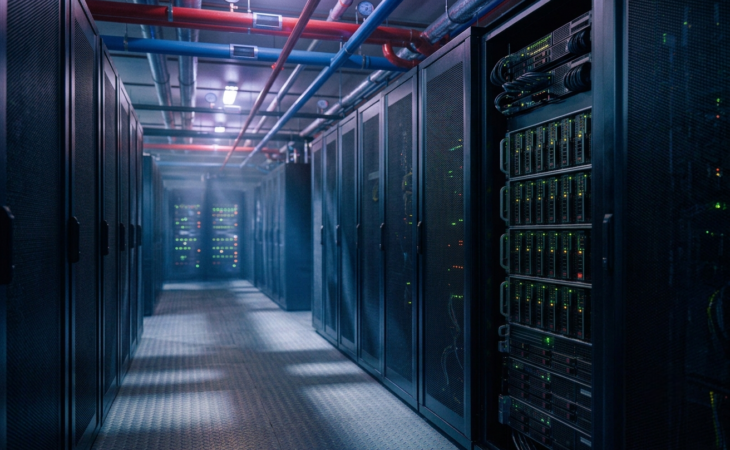
You’ve successfully raised the capital, signed the power grid contracts, and built a liquid-cooled AI factory. Your clusters run next-gen hardware, and enterprise tenants are deep into a multi-week foundation model training run. Everything is running smoothly.
Then, it’s 2:00 AM on a Tuesday. A random hardware fault trips a system-wide freeze. The training pipeline crashes cold.
If your infrastructure runs on reactive operations, your SRE (Site Reliability Engineering) team spends the next four hours combing fragmented dashboards and Prometheus logs, guessing why the cluster flatlined. Meanwhile the client’s training run sits stalled, the amortization clock ticks, and billable compute vaporizes by the thousands of dollars each hour—making the real-world AI data center downtime cost per hour critical metrics for operational survival.
This is the industry standard for large-scale AI infrastructure. But it doesn’t have to be.
Operating high-density GPU infrastructure means living with fragility. Meta’s Infrastructure Team documented the scale of it in their report on LLaMA 3 clusters: across a 54-day training run on 24,576 H100 GPUs, the cluster suffered 419 unplanned interruptions.
58.7% of those failures traced back to low-level hardware faults: GPU malfunctions, HBM3 memory failures, and NVLink network fabric congestion. Industry insiders call this pattern the “Meta Drop.”
The standard mitigation is a brute-force process called “Restart and Requeue.” Traditional platforms can only react after a crash, so the job aborts, the system isolates the dead node, and the workload rolls back to the last saved checkpoint.
SemiAnalysis research quantifies the financial erosion this legacy workflow causes:
research this legacy workflow introduces a hidden financial drain known as GPU checkpoint restart cost / checkpoint tax:
The Checkpoint Tax: Writing checkpoint states to flash storage every few hours drags performance, consuming memory and network bandwidth.
The Rollback Waste: Every “Restart and Requeue” cycle costs 1 to 3 hours of compute progress.
For a large-scale enterprise customer, those lost hours turn expensive megawatts and depreciation costs into useless ambient heat, severely compromising your contractual Service Level Agreements (SLAs) and increasing the GPU cluster downtime cost.
Software point solutions have emerged claiming to fix this with “live migration.” They share one flaw: they only look at the IT layer.
A single-layer software tool lives inside the cloud orchestration stack. It tracks Kubernetes pod status, detects a late-stage GPU memory ECC error, or monitors application runtimes. It has no visibility into the physical data center environment.
This creates a blindspot. In a high-density, liquid-cooled data center, software anomalies are usually symptoms of physical infrastructure constraints.
When a secondary liquid cooling loop develops a micro-leak, or a Cooling Distribution Unit (CDU) shows a subtle pressure drop, no single-layer IT tool can diagnose it. By the time a software-only tool registers that a GPU overheated and dropped clock cycles, the chip has already sustained thermal fatigue. You can’t run an effective GPU failure prediction machine learning model when your telemetry platform is half-blind.
Building a resilient AI Factory means eliminating the barrier between bits and watts. Federator.ai Cortex does this: the industry’s only autonomous operations platform that unifies IT orchestration with OT infrastructure control into a single, closed-loop machine intelligence plane.
Instead of relying on reactive, human-dependent runbooks, Federator.ai Cortex deploys a multi-layered predictive architecture driven by TadGAN (Time-Series Anomaly Detection via Generative Adversarial Networks).
Federator.ai Cortex’s TadGAN predictor doesn’t just watch static alert thresholds. It samples millions of real-time datastreams across the infrastructure: per-GPU data via DCGM Exporters and physical facilities metrics via Redfish APIs.
By correlating signals across these layers, Federator.ai Cortex catches microscopic hardware degradation with 94% prediction accuracy up to 72 hours in advance. It flags a failing component before it flatlines, spotting a liquid cooling failure days before it can disrupt your application stack.
Predictive accuracy without automated action is an expensive notification. Federator.ai Cortex closes that gap with predictive AI workload migration, powered by the Federator.ai kMotion engine.
When Cortex’s predictive analytics flag a node with a high probability of failure, it commands kMotion to run a coordinated mitigation workflow, delivering zero-downtime GPU cluster recovery instead of a destructive “Restart and Requeue” loop.
To keep migrations stable in production environments, kMotion uses a multi-tier architecture:
The Technical Mechanics of kMotion: kMotion orchestrates pod migration by blending Kubernetes scheduling with low-level GPU orchestration. For Intra-node Migration (within the same server), it uses CUDA and NVLink fabrics for near-instant GPU state transfers. For Inter-node Migration (across servers), it uses Kubernetes Volume Snapshots with Federator.ai’s predictive analytics to migrate stateful data without disrupting live training execution states.
Global Decision-Making (No Cluster Thrashing): A critical flaw in basic migration tools is the “race condition”: migrating a workload to a target node that’s already congested. kMotion solves this with global recommendations from the Federator.ai GPU Booster. It checks GPU utilization, network capacity, and cluster topology before a single container moves, eliminating resource thrashing.
Stateful Preservation & Graceful Isolation: Using Kubernetes StatefulSets, Node Affinity, and Taints/Tolerations, kMotion keeps stateful applications’ identity and ordering intact. The compromised node drains, isolates, and the tenant’s AI training run continues uninterrupted.
| Comparison Dimension | Traditional Checkpoint Approach | kMotion + GPUHealthCheck Approach |
|---|---|---|
| Core Strategy | Reactive Fault Tolerance: Recovers from the last saved state after a failure occurs. | Proactive Defense: Migrates workloads before an impending failure manifests. |
| Operational Mechanism | Periodically writes training progress and weights to storage. If a GPU fails and crashes the job, training must resume from the last-saved checkpoint. | Continuously checks cluster health via predictive APIs. Upon detecting potential failure, it instantly triggers volume snapshots and migrates the Pod to a healthy node. |
| Time & Resource Waste | High. Causes system downtime between the crash and restart, and completely loses all computing progress made since the last checkpoint. | Minimal. Completes Pod migration with minimal to zero downtime; training continues seamlessly without losing any progress. |
| Cluster Stability | Vulnerable to massive sudden node crashes, which can trigger collective restarts and cause cluster thrashing or race conditions. | Leverages Federator.ai GPU Booster to provide global recommendations and coordinate migration timing, effectively preventing cluster thrashing. |
What causes the 58.7% training failure rate in large-scale AI clusters?
As documented by Meta’s infrastructure engineering team during large-scale LLM training runs, approximately 58.7% of unplanned training interruptions are driven strictly by low-level hardware faults. The primary culprits are high-bandwidth memory (HBM3) failures, sudden GPU core instabilities, and thermal fatigue or signal degradation within the NVLink network fabric.
How does kMotion live AI workload migration work without pausing PyTorch jobs?
Unlike reactive point solutions that rely on cluster-wide checkpoint rollbacks, kMotion live AI workload migration leverages full-stack orchestration to clone the active runtime memory and state of an ongoing AI workload. By coordinating with the underlying Kubernetes scheduling plane and utilizing high-speed hardware channels like NVLink or Kubernetes Volume Snapshots , kMotion seamlessly transfers active compute states to healthy target nodes with zero of execution downtime.
What is TadGAN anomaly detection in B2B AIOps?
TadGAN (Time-Series Anomaly Detection via Generative Adversarial Networks) is an advanced machine learning framework used by Federator.ai Cortex to analyze complex multi-layer data center telemetry. By modeling expected temporal behavior across correlated metrics—such as matching live CUDA kernel step loads with smart PDU current telemetry and CDU cooling loop pressure deltas—TadGAN identifies hardware degradation trends days in advance with 94% accuracy.
What is cluster thrashing, and how does kMotion prevent it?
Cluster thrashing happens when a distributed system burns more time and resources on administrative overhead — scheduling, restarting, moving workloads — than on actual computing tasks. Left unchecked, it stalls training runs and wastes GPU-hours you’re already paying for. In a large AI data center, one GPU failure can set off a chain reaction. Reschedule a massive training Pod onto the nearest node without checking capacity, and that node overloads and crashes too. Pods bounce from node to node, and your LLM training job gets stuck in a loop of timeouts and restarts.
Federator.ai kMotion analyzes predictions across the entire cluster, factoring in overall GPU utilization and network capacity before making a move. It staggers and coordinates the timing of migrations to ensure moving a Pod won’t inadvertently trigger a crash somewhere else, keeping AI data centers running smoothly.
Unplanned downtime kills margins in modern AI compute. If you run a high-density data center with single-layer software tools and manual runbooks, physical infrastructure constraints will beat you.
Federator.ai Cortex delivers a 90% reduction in unplanned downtime and extends hardware lifespans by up to 30%, turning operational fragility into a financial asset.
See how Federator.ai Cortex can transform your operational efficiency:
>> Schedule an Architecture Deep Dive with Our Engineering Team
Please select the software/ platform you would like a demo of: