
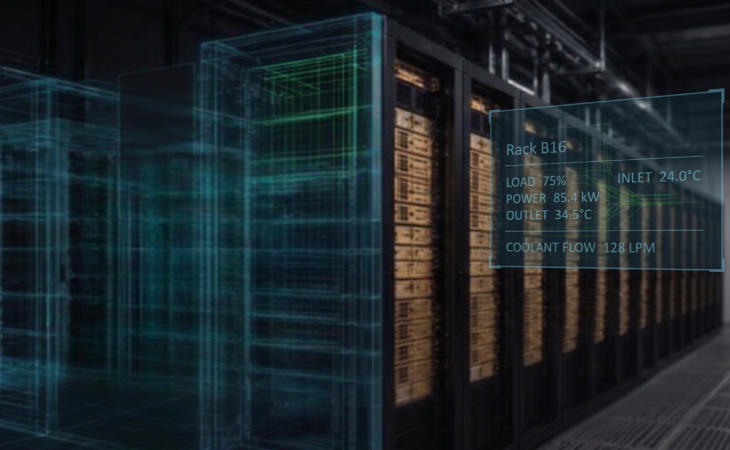
The way we value and build data centers is broken.
For the last three decades, digital infrastructure was a game of high-tech real estate. You acquired land, locked down a fat power contract, threw up some concrete, and leased out square footage and Megawatts (MW). Underwriters loved it because the math was simple.
But in the era of generative AI, individual racks scale past 100kW and hardware generations turn over in 18 months. Leased capacity is a vanity metric. Goldman Sachs Insights predicts that the industry’s shift to always-on AI agents running continuous autonomous loops will drive a sharp increase in compute volume (a 24-fold increase in token consumption by 2030) and tech cash flows.
If you run an AI Factory or enterprise infrastructure, you sell tokens, training hours, and compute throughput, not megawatts. Your revenue scales with tokens per watt. Deployed capacity that sits idle generates no value; monetizable density over time does. That is the GPU Infrastructure Yield Layer.
Enterprise GPU clusters run at 5% average utilization, according to a recent VentureBeat AI Infrastructure Tracker. Even in specialized GPU clouds, static scheduling and siloed operations hold sustained utilization below 50%.
A single GB200 NVL72 rack commands $18,000 to $28,000 per day in on-demand compute revenue (GB300 pricing runs higher). At those rates, idle time is not an operational inconvenience; it is a predictable cash burn. (Deploying AI: NVIDIA GB200 Tracking, updated June 22, 2026).
The root cause is a fractured tech stack. IT teams manage Kubernetes clusters, CUDA kernels, and PyTorch jobs. Facilities teams (OT) manage Cooling Distribution Units (CDUs), secondary liquid loops, and Building Management Systems (BMS).
These two layers share no data and no coordination. Each team operates without visibility into what the other is doing.Picture an investor who spends hundreds of millions on a fleet of autonomous luxury vehicles. The garage maintenance crew (OT) and the dispatch app team (IT) run as separate organizations with no shared data.
When ride requests surge (workloads), the gap plays out in two directions:
In High-Demand Zones: A fraction of the cars run at their limits, overheating engines while riders wait in queue and abandon the platform.
In Low-Demand Zones: Half the fleet sits idle, accumulating opportunity cost.
You pay 100% of operational overhead for an expensive fleet that cannot coordinate with dynamic customer demand.
A siloed data center breaks down the same way. When a multi-node LLM training job starts, power draw and heat spikes instantly. If the liquid cooling loop reacts too slowly, a tiny 2–3°C temperature drift in coolant supply temperature throttles GPU clocks across the whole cluster.
Business leader see margin erosion. SREs spend hours digging through separate dashboards to find the root cause while million-dollar training runs stall.
[ Industry Average GPU Utilization < 50% ] → The “Stranded Capital” Gap
[ Federator.ai Cortex Sustained Yield: 95%] → +50pp Revenue Leverage
Closing that gap requires an intelligence layer that connects active workloads with physical infrastructure. Federator.ai Cortex does that.
Federator.ai Cortex is a closed-loop autonomous execution system that unifies IT telemetry (jobs, kernels, GPU metrics) with OT telemetry (CDUs, flow rates, power feeds). Its Model Predictive Control (MPC) framework predicts future thermal loads and equipment behavior; it optimizes cooling resources proactively rather than reacting to temperature deviations after they occur. This results in more stable temperature regulation, reduced energy consumption, and smoother operation of cooling systems.
Federator.ai Cortex runs our patented Multi-Layer Correlation technology (US Patent 11,579,933): a 12-agent Bayesian Directed Acyclic Graph (DAG) that maps causal relationships across 16 failure modes in real time. When performance degrades, Federator.ai Cortex pinpoints whether the root cause is NVLink congestion or a drop in secondary loop pressure.
Federator.ai Cortex implements AI-driven Model Predictive Control (MPC) with feedforward loop tuning. The MPC for CDU flow rate in liquid-cooled AI racks continuously samples the KAI Scheduler’s job queue telemetry, predicts each workload’s thermal footprint, and modulates liquid flow rates before the junction temperature rises, boosting cooling throughput by up to 45%.
NVIDIA’s recent DSX platform announcement (May 2026) confirms the direction: connecting IT workloads to physical facility infrastructure is the central challenge of the AI factory era. DSX Exchange, NVIDIA’s open-source IT/OT communication layer, creates the signal bus, surfacing thermal readings, power anomalies, and grid events to the software layer above it.
But a signal bus is not a closed-loop execution engine.
Federator.ai Cortex operates at the intelligence layer above that bus. Where DSX connects the systems, Federator.ai Cortex decides what to do and acts on it autonomously. It ships with cross-layer causal reasoning and workload-aware thermal actuation out of the box, without requiring operators to wire together MCP servers, AI agents, and custom decision logic.
The stack divides cleanly: DSX provides open infrastructure plumbing; Federator.ai Cortex provides the closed-loop yield intelligence that converts those signals into billable throughput.
Connecting bits to watts changes the financial profile of a data center. The core equation:
Federator.ai Cortex shifts operators from volatile capacity claims to predictable Yield Assurance.
What is a Yield Layer in AI Factory operations?
The GPU Infrastructure Yield Layer is an operational software plane—pioneered by Federator.ai Cortex—that sits natively between cloud orchestration software (IT) and physical facility infrastructure (OT). It applies cross-layer causal analysis to ensure that every watt of supplied power is directly converted into the maximum possible output of billable, high-performance tokens.
What is GPU stranded capacity in AI data centers?
GPU stranded capacity refers to expensive, installed compute hardware that sits idle or under-utilized due to rigid software scheduling, network fabric bottlenecks, or physical cooling constraints. Because traditional facility management operates siloed from active AI workloads, clusters frequently suffer from “thermal drifts” that force chips to drop clock cycles, effectively burning capital. This is precisely the critical pain point that modern AI factories solve by deploying Federator.ai Cortex’s unified IT + OT closed-loop system: turning stranded power back into billable GPU hours.
What causes thermal throttling in high-density GPU clusters?
Thermal throttling occurs when a GPU’s junction temperature exceeds its optimal operational threshold, forcing the internal hardware protection layer to down-clock the core frequency to prevent physical damage. In high-density environments (such as 100kW+ liquid-cooled racks), this is typically caused by a 2–3°C temperature drift in the coolant supply line because traditional Building Management Systems (BMS) cannot react fast enough to sudden workload load-step spikes. With AI-driven Smart Liquid Cooling, Federator.ai Cortex employs workload-aware thermal management with PID and feedforward control to modulate cooling flows dynamically.
Treating data centers as real estate no longer works. The AI Factories that win won’t be those with the most megawatts. They’ll be the ones who extract the most billable throughput from the capital they’ve already deployed.
See how Federator.ai Cortex can transform your operational efficiency:
>> Schedule an Architecture Deep Dive with Our Engineering Team
Please select the software/ platform you would like a demo of: